planning
Council decision times on small housing schemes range from 56 to 230 days, Trove table shows
Land-sourcing platform Trove has published a council-by-council league table of decision times on schemes of one to nine homes, as HBF's SME survey again puts planning delay top of builders' barriers.
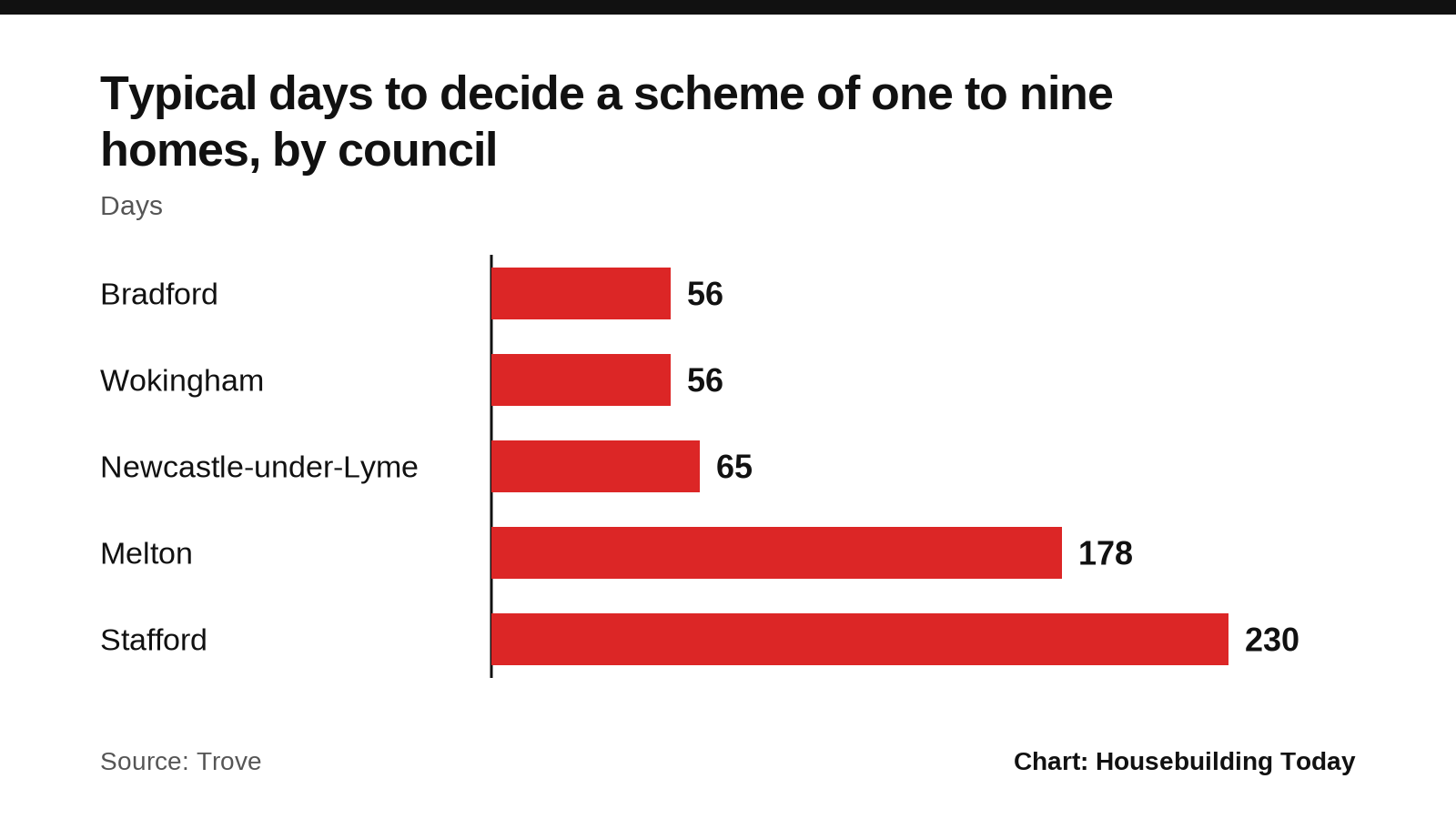
Leeds-based land platform Trove has released council-level figures showing the typical time to decide a planning application for one to nine homes ranges from 56 days in Bradford and Wokingham to 230 days in Stafford, against an eight-week target.
The figures come from Trove's council planning league table, which the company said it keeps up to date as new decisions come in. In an email to the desk, with data as at 7 November 2026, founder Nathan Parks said the middle council of the 105 then ranked across 21 counties took 92 days to decide a small scheme.
Trove said only two of those 105 councils, Bradford and Wokingham, decided half or more of small schemes inside eight weeks. The email put Bradford's on-time share at 55% and Wokingham's at 52.4%; the live table row for Bradford shows 54.9%. Trove said Melton took a typical 178 days.
The table has grown since the email was sent. As at 17 November 2026, the live page covers 127 councils in 23 counties, with 113 ranked on 94,166 decisions and 14 not ranked, drawing on 92,136 small-scheme decisions. Trove states on the page that the table is not England-wide.
The figures
| Council | Typical days to decide a small scheme |
|---|---|
| Bradford | 56 |
| Wokingham | 56 |
| Newcastle-under-Lyme | 65 |
| Melton | 178 |
| Stafford | 230 |
Source: Trove. Bradford, Wokingham and Melton figures are from Trove's email (data at 7 November); Newcastle-under-Lyme and Stafford from the live table (data at 17 November).
According to the live table, the widest gap between neighbouring councils is Stafford at 230 days against Newcastle-under-Lyme at 65. Bradford decides small schemes 31 days faster than the West Yorkshire county figure of 87 days, and Wokingham 18 days faster than Berkshire's 74 days, Trove said.
How the clock is measured
Trove's method differs from the government's. The company said its clock runs from receipt to decision, so it includes time an application spent back with the applicant, and covers new homes only, decided since 1 January 2021. "Typical" means the median.
Crucially, Trove does not count a decision made within an agreed extension of time as on time. "Official figures count a decision made within an agreed extension of time as on time; ours do not," the company said, adding that its on-time shares therefore run lower than official figures.
The official comparator shows how much that choice matters. The Ministry of Housing, Communities and Local Government's statistical release for April to June 2026 found 87% of minor applications in England were decided within eight weeks or the agreed time, but only 39% within the statutory eight-week period. District-level authorities reported 74,500 planning decisions in the quarter, down 8%.
Trove's earlier planning clock study, which analysed 18,020 residential decisions across 13 Yorkshire councils from January 2021 on its record as at 26 August 2026, found a small residential application took 96 days at the median. The company said the study found that how fast a council decides says almost nothing about whether it approves.
The HBF context
Trove sent the figures to sit alongside the Home Builders Federation's State of Play 2026/27 survey of SME home builders, the seventh iteration of the report, produced in partnership with Close Brothers Property Finance and VELUX.
HBF found 88% of respondents identified delays in securing planning permission as a barrier, down from 94% in last year's survey. The federation said planning delay has been cited as the biggest major challenge for the seventh consecutive time. By region, 90% of respondents in the Central region named it, 86% in the North and 85% in the South.
HBF also found 82% identified cumulative viability pressures as a major barrier, and 63% had delayed progressing a site or put work on hold.
Neil Jefferson, Chief Executive of the Home Builders Federation, said complexity, costs and delays continue to constrain SMEs' ability to deliver new homes.
He added: "This means going beyond planning reform alone to address the wider barriers holding back SME development."
Trove, operated by Nathan Parks Ltd (company number 10972456) from a registered office in Leeds, describes itself as a decision-support platform for sourcing residential land in England. It said the league table is free to cite, link to or embed, and that its data was last updated on 17 November 2026.
On the record: Home Builders Federation, Ministry of Housing, Communities and Local Government
Sources
- Trove (opens in a new tab) (accessed 2026-11-20)
- Trove (opens in a new tab) (accessed 2026-11-20)
- Trove (opens in a new tab) (accessed 2026-11-20)
- Trove (opens in a new tab) (accessed 2026-11-20)
- Home Builders Federation (opens in a new tab) (accessed 2026-11-20)
- Home Builders Federation (opens in a new tab) (accessed 2026-11-20)
- Ministry of Housing, Communities and Local Government (opens in a new tab) (accessed 2026-11-20)
This story was researched from the primary sources above and checked against them before publication. Spotted an error? Tell us and we will correct it promptly.