policy
HM Land Registry data shows avoidable requisition points down 47.7% since 2022
The registry's third avoidable requisitions dataset, covering April to September 2026, arrives as its analysis puts the saving in industry time at about £12m and sets out further changes.
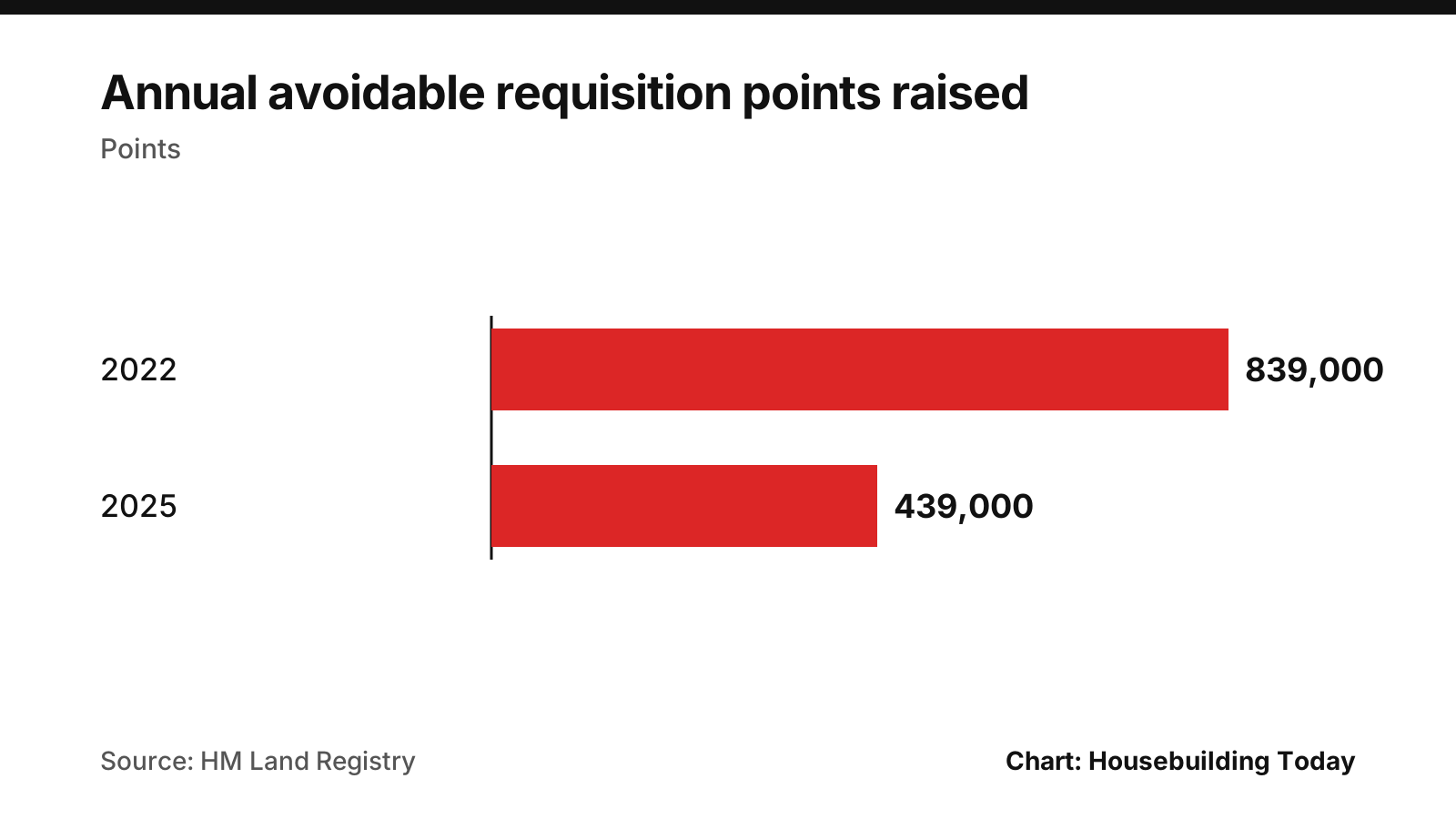
HM Land Registry published its third avoidable requisitions dataset on 2 November 2026, alongside analysis showing the number of avoidable requisition points raised each year fell 47.7% between 2022 and 2025.
The dataset covers applications processed between 1 April and 30 September 2026. HM Land Registry said it is intended to help conveyancers and law firms review the quality of their applications and direct checks, training and quality assurance where they will make the most difference.
According to the registry, annual avoidable requisition points fell from about 839,000 in 2022 to 439,000 in 2025. After adjusting for application volumes, the rate fell 39.1% over the same period, which it said showed the improvement was not simply the result of fewer applications.
Andrew Robertson, Head of Customer Policy at HM Land Registry, said: "Reducing avoidable requisitions is a shared achievement. Conveyancers, post-completion teams and industry bodies have worked with us to improve application quality, helping to reduce unnecessary work and delays for everyone involved."
| Year | Avoidable requisition points |
|---|---|
| 2022 | 839,000 |
| 2025 | 439,000 |
The 2026 figures
Between January and September 2026, about 94 avoidable points were raised per 1,000 applications, HM Land Registry said, an 11% reduction in the rate compared with 2025. In its 12 October blog the registry put that figure at almost half (46%) the 2022 level.
The registry cautioned that its figures count requisition points, not applications or letters, and that more than one point can be raised in a single requisition. A rate of 94 points per 1,000 applications therefore does not mean 9.4% of applications received an avoidable requisition.
It also said the 2022 to 2026 trend figures come from its wider analysis published in October 2026 blogs and should not be described as a comparison of the three published datasets.
A requisition is a request for more information or action before an application can be completed. HM Land Registry said avoidable points cover errors or omissions that could usually have been prevented before submission, such as missing identity evidence, discrepancies in names, unclear plans or missing supporting documents.
Despite the progress, the registry said missing or unclear information is now the most common broad category of avoidable requisition, and identity evidence not being supplied is the most common individual point.
The cost to the industry
In its 12 October blog, HM Land Registry estimated the fall in avoidable requisition points represents a saving of about £12m in industry time spent resolving preventable issues. The estimate uses an indicative benchmark of up to £31.42 per avoidable requisition point.
The registry's economists estimated in 2024 that avoidable errors cost the industry between £3.2m and £19.1m a year. HM Land Registry said at the time that requisitions add on average 15 working days to the time taken to register a transaction.
The registry's own quality checks also show movement, according to the October blog. Quality issues affected 12% of checked cases in 2022/23, falling to 10% in 2024/25 and 8% in 2025/26.
Stephen Ward, Deputy Chief Executive of the Council for Licensed Conveyancers, said: "The publication of data on avoidable requisitions is proving to be just as constructive as we had hoped."
How the dataset works
HM Land Registry said firms are included in the dataset only if it processed at least 10 of their applications in the reporting period. The dataset measures avoidable requisition rates rather than volumes, so firms of different sizes can be compared.
In December 2025, when it published avoidable requisitions data, the registry said 20% of firms had an avoidable requisition rate under 1%, up from 17% a year earlier, and 57% had rates below 5%. A dataset announced in June 2026 showed rates down 7% over the previous six months.
In June the registry said the next dataset would be published in December. The third release came on 2 November.
HM Land Registry said it has emailed each firm's Responsible Person, the individual overseeing its online account, with more detailed information on the requisition points the firm received. It currently sends this data to customers every six months.
What happens next
In its 19 October blog, HM Land Registry set out further steps. It plans to make avoidable requisition data available to firms through its Portal, and to link customers to relevant guidance and training in requisition letters where this can help prevent a recurring issue.
The registry said it will review how requisitions are raised so they are necessary, clearly explained and correctly recorded, and will explore ways to simplify its fees.
Its Tackling avoidable requisitions guidance applies to England and Wales. HM Land Registry said more than 4,000 staff had been trained by its Land Registration Academy since 2021.
Sources
- HM Land Registry (GOV.UK) (opens in a new tab) (accessed 2026-11-03)
- HM Land Registry (opens in a new tab) (accessed 2026-11-03)
- HM Land Registry (opens in a new tab) (accessed 2026-11-03)
- HM Land Registry (GOV.UK) (opens in a new tab) (accessed 2026-11-03)
- HM Land Registry (opens in a new tab) (accessed 2026-11-03)
- HM Land Registry (opens in a new tab) (accessed 2026-11-03)
- HM Land Registry (GOV.UK) (opens in a new tab) (accessed 2026-11-03)
This story was researched from the primary sources above and checked against them before publication. Spotted an error? Tell us and we will correct it promptly.