housebuilders
SME housebuilder confidence falls again as starts balance drops to -43, HBF survey finds
The fourth quarterly HBF and Quantum Development Finance survey of 115 SME developers found 61% expect to start fewer homes, with viability, planning delays and mortgage rates cited as growing barriers.
Confidence among small and medium-sized housebuilders in England and Wales has fallen for a further quarter, with 61% expecting to start fewer homes over the next three months, according to the Home Builders Federation (HBF).
The fourth quarterly SME Developer Sentiment Survey, published by HBF with Quantum Development Finance, drew 115 responses from SME developers between 21 September and 9 October. HBF said the survey was open to all SME home builders, not only its members, and that the 115 responses were in line with the 114 received in the previous survey.
HBF said the net balance for housing starts fell from -28 percentage points in the third quarter to -43 in the fourth. The net balance for land purchasing was -38 percentage points, compared with -39 in the third quarter, with 58% of respondents expecting to buy less land than in the previous quarter.
Some 96% of respondents said current market conditions were making them cautious about bringing forward new developments, HBF said.
The barriers
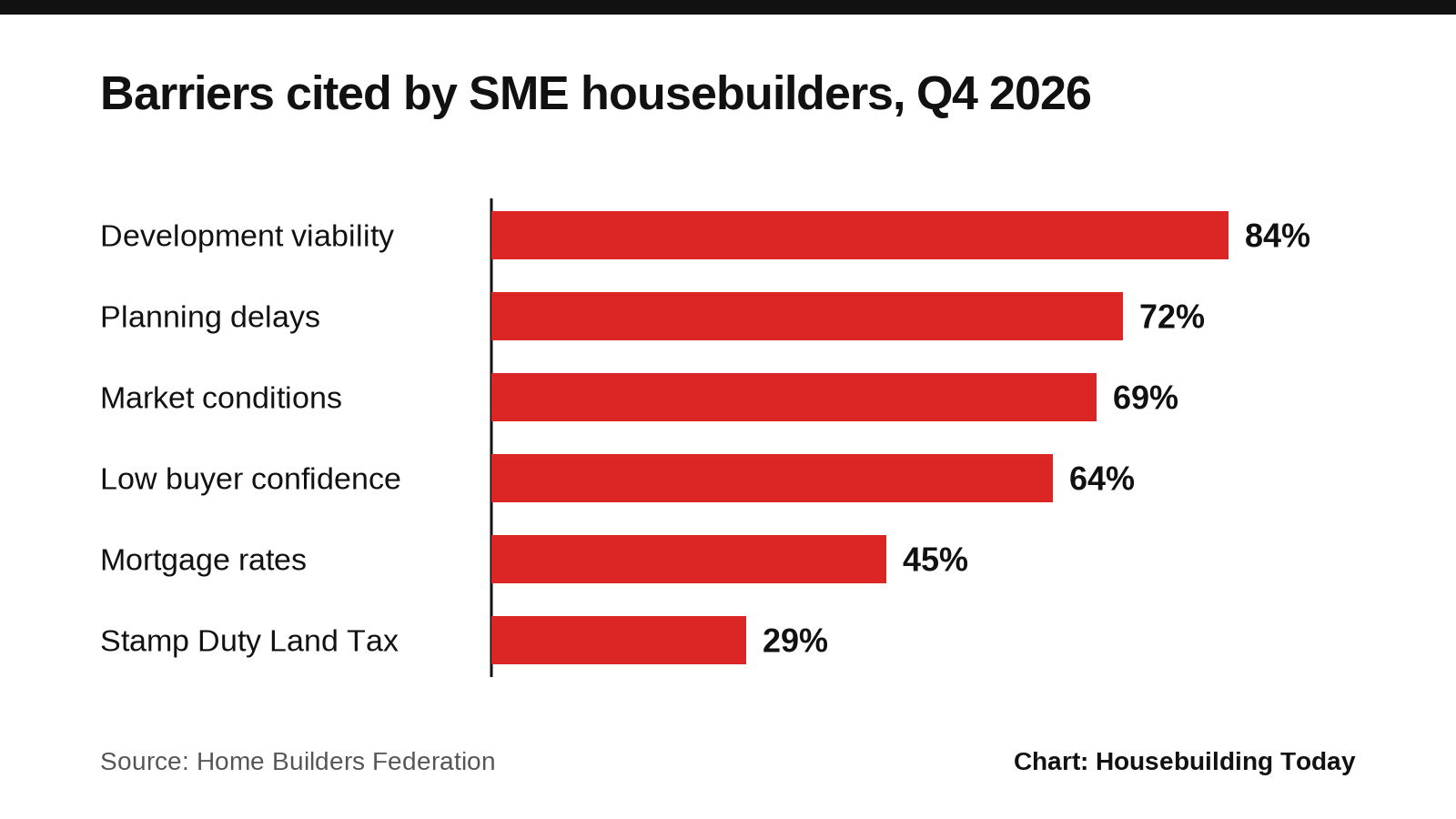
Development viability was the most cited supply-side constraint, identified by 84% of respondents, followed by planning delays at 72%. In the third quarter survey, published by HBF in August, the equivalent figures were 75% and 68%.
On the demand side, HBF said general housing market conditions (69%) and low buyer confidence (64%) were the most common concerns. Mortgage rates were cited by 45% of respondents, up from 26% in the previous quarter, while Stamp Duty Land Tax was cited by 29%, compared with 31% in Q3.
| Constraint cited in Q4 2026 | Respondents |
|---|---|
| Development viability | 84% |
| Planning delays | 72% |
| Housing market conditions | 69% |
| Low buyer confidence | 64% |
| Mortgage rates | 45% |
| Stamp Duty Land Tax | 29% |
HBF said 95% of respondents were not very confident or not at all confident that the current policy agenda would deliver meaningful improvements for SME builders.
Your First Home
Three-quarters of respondents (75%) said targeted demand-side measures, such as the Government's Your First Home equity loan scheme or Stamp Duty Land Tax reform, could encourage them to plan additional site starts. HBF said demand-side interventions could influence the development plans of 93% of SME home builders.
HBF said the effect would depend on how Your First Home is designed and implemented, including its eligibility criteria, accessibility and ability to stimulate additional buyer demand, and on how SME builders are able to take part.
According to the Ministry of Housing, Communities and Local Government, Your First Home will help first-time buyers purchase a new-build home in England with a deposit of at least 2.5% and a government equity loan worth 20% of the purchase price, interest free for five years. The department said £4.7bn of funding is available over five years and that the scheme is expected to open for applications in February 2027, with pre-registration before the end of 2026.
Buyers must have a household income of £110,000 or less outside London, or £140,000 or less within London, the department said.
Section 106 affordable homes
The survey also asked SMEs about securing bids from Registered Providers (RPs) for Section 106 affordable homes. HBF said 72% reported significant or moderate difficulty, with 47.4% reporting significant difficulty and 1.8% reporting none.
The most common reason given for a lack of bids was that the scheme size or number of affordable homes was too small to be attractive, cited by 70.5% of respondents. A lack of RP funding or borrowing capacity was cited by 48.2% and RPs prioritising grant-funded or other opportunities by 43.8%. Only 6.3% identified unit type, size, specification or design as a common barrier, HBF said.
HBF said 92% of respondents agreed that the Government's decision not to allow financial contributions in place of on-site affordable homes would harm viability, and 82.5% strongly agreed that Section 106 agreements should include a mandatory cascade mechanism. HBF said it has been calling for cascade mechanisms to be made mandatory in Section 106 agreements.
Of 83 respondents who had sought a Deed of Variation, 49.4% said requests to vary tenure or make a payment in lieu were received negatively by the local planning authority.
HBF's December 2024 Bid Farewell report found at least 17,432 Section 106 affordable homes with detailed planning permission were uncontracted and counted 139 sites delayed as a result.
Who responded
Respondents ranged from developers building a handful of homes a year to about 500, with 69% building 100 homes or fewer. The South East (37%), East Midlands (23%), South West (22%) and West Midlands (21%) were the most represented regions.
HBF describes Quantum Development Finance as a specialist lender providing short to medium-term finance to SME housebuilders. The previous survey ran from 15 July to 1 August 2026.
On the record: Home Builders Federation, Ministry of Housing, Communities and Local Government
Sources
- Home Builders Federation (opens in a new tab) (accessed 2026-11-27)
- Home Builders Federation (opens in a new tab) (accessed 2026-11-27)
- Home Builders Federation (opens in a new tab) (accessed 2026-11-27)
- Ministry of Housing, Communities and Local Government (GOV.UK) (opens in a new tab) (accessed 2026-11-27)
- Home Builders Federation (opens in a new tab) (accessed 2026-11-27)
This story was researched from the primary sources above and checked against them before publication. Spotted an error? Tell us and we will correct it promptly.