policy
Leasehold reform Bill enters Parliament with commonhold as default for new flats
The Commonhold and Leasehold Reform Bill, introduced on 19 November, would make commonhold the standard tenure for most new flats, cap ground rents at £250 a year from 2028 and halve the conversion threshold for existing blocks.

The Commonhold and Leasehold Reform Bill enters Parliament today, 19 November, with commonhold to become the default tenure for most new flats in England and Wales, the Ministry of Housing, Communities and Local Government (MHCLG) said.
The department said the Bill would cap ground rents at £250 a year, curb administration fees, make lease extensions and freehold purchases cheaper and end the threat of forfeiture over small unpaid charges. It said there are an estimated five million leasehold homes across England and Wales.
For housebuilders, the central change is the ban on leasehold for new flats and homes. MHCLG said modernised commonhold would become the standard for most new flats, with narrow exceptions such as shared ownership, so buyers own their home outright and run the building jointly from the start.
Matthew Pennycook MP, Minister for Housing, said: "The publication of our historic Commonhold and Leasehold Reform Bill marks the beginning of the end for the feudal leasehold system."
What the Bill does
The ground rent cap of £250 a year takes effect in 2028. MHCLG said it would cut bills for up to one million leaseholders and reduce ground rents to zero after 40 years.
Existing blocks would be able to convert to commonhold with the support of 50% of neighbours, down from 100%. Leaseholders who do not consent would stay on modified leases until they sell, so holdouts could not block conversion for the rest of the building, the department said.
The Bill also amends parts of the Leasehold and Freehold Reform Act 2024. MHCLG said this would enable 990-year lease extensions, stop leaseholders paying their landlord's costs in most cases and scrap marriage value, a cost faced by leaseholders with 80 years or less remaining on their leases.
Ministers would gain powers to cap permission and administration fees, such as charges for keeping a pet or replacing a front door. MHCLG said separate legislation would also create an independent regulator of property agents.
On freehold estates, the Bill would protect up to 1.75 million homes on so-called "fleecehold" estates by removing powers that allow management companies to take over homes over unpaid fees, according to the department.
Professor Nick Hopkins, Chair of the Leasehold Advisory Service (LEASE), said: "Moving towards commonhold, with an easier route for existing leaseholders to convert, is the most significant change to home ownership for a generation." He said LEASE is developing guidance on the new commonhold model.
Hopkins was appointed Chair of LEASE on 2 November 2026, taking over from Martin Boyd, who had led the body since 2023. He is Professor of Land Law at University College London and previously served as Law Commissioner for Property, Family and Trust Law.
The leasehold stock
MHCLG puts the total at 5.1 million leasehold homes, about 4.9 million in England and 235,000 in Wales. Of the English total, it said 2.72 million are owner-occupied, 1.91 million privately rented and 269,000 social rented.
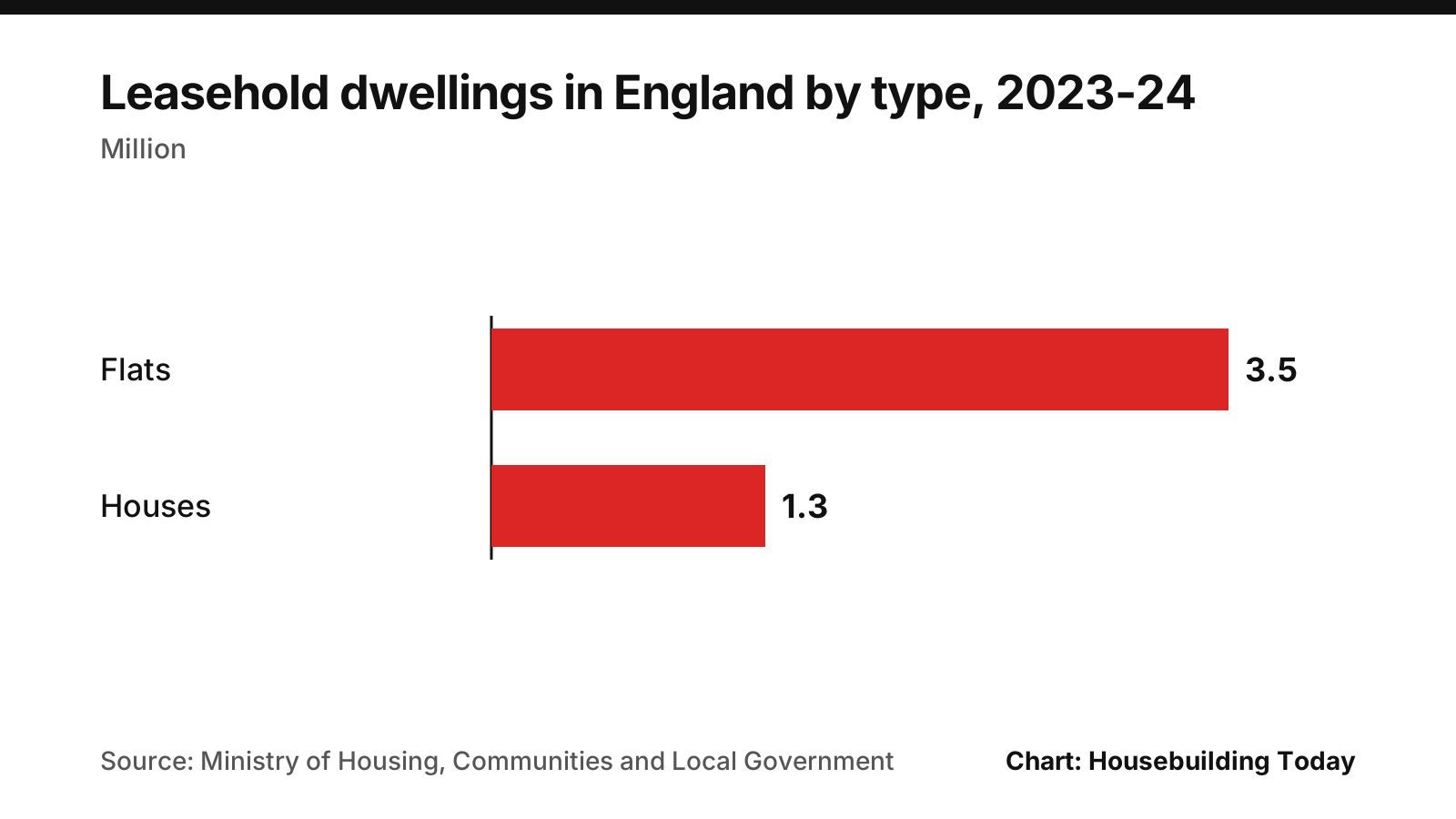
Official statistics for 2023-24, published by MHCLG, estimated 4.83 million leasehold dwellings in England, 19% of the housing stock. Of those, 2.59 million (54%) were owner occupied.
| Leasehold dwellings in England, 2023-24 | Million |
|---|---|
| Flats | 3.5 |
| Houses | 1.3 |
Flats made up 72% of English leasehold dwellings and houses 28%, according to the statistics.
How the Bill got here
MHCLG published the draft Bill on 27 January 2026, proposing a ban on leasehold for most new flats. The Housing, Communities and Local Government Select Committee began pre-legislative scrutiny on 4 February 2026.
Professor Lisa Webley, Law Commissioner for Property, Family and Trust Law, welcomed the draft Bill's implementation of Law Commission recommendations on commonhold and termination of tenancies.
The Welsh Government, in a written statement by Jayne Bryant MS, Cabinet Secretary for Housing and Local Government, described the draft as proposing welcome changes to home ownership law in England and Wales and said it continues to work with the UK Government on the reforms.
On 29 September 2026 the government confirmed it would legislate to let the Secretary of State cap permission fees, saying the changes were intended to support over five million existing leaseholders. On 11 November 2026 MHCLG said over three million leaseholders in England would benefit from stronger service charge rights, with powers to demand information about service charges from 1 April 2027 and councils and housing associations required to provide standardised service charge information from 1 November 2028.
Earlier measures under the 2024 Act have already taken effect: the two-year ownership wait before extending a lease or buying a freehold was scrapped on 31 January 2025, and Right to Manage reforms came into force on 3 March 2025.
What happens next
The Bill applies to England and Wales only, as property law is devolved in Scotland and Northern Ireland. MHCLG said the reforms depend on passage through Parliament and Royal Assent, with the ground rent cap scheduled for 2028.
On the record: Ministry of Housing, Communities and Local Government, Leasehold Advisory Service
Sources
- Ministry of Housing, Communities and Local Government (opens in a new tab) (accessed 2026-11-19)
- Ministry of Housing, Communities and Local Government (opens in a new tab) (accessed 2026-11-19)
- Ministry of Housing, Communities and Local Government (opens in a new tab) (accessed 2026-11-19)
- Ministry of Housing, Communities and Local Government (opens in a new tab) (accessed 2026-11-19)
- Ministry of Housing, Communities and Local Government (opens in a new tab) (accessed 2026-11-19)
- Ministry of Housing, Communities and Local Government (opens in a new tab) (accessed 2026-11-19)
- Law Commission (opens in a new tab) (accessed 2026-11-19)
- Welsh Government (opens in a new tab) (accessed 2026-11-19)
This story was researched from the primary sources above and checked against them before publication. Spotted an error? Tell us and we will correct it promptly.