policy
Stoke-on-Trent approves city-wide Article 4 Direction on small HMO conversions
Stoke-on-Trent City Council's Cabinet has backed a city-wide Article 4 Direction removing permitted development rights for converting family homes into small HMOs, with a statutory consultation still to run before confirmation.
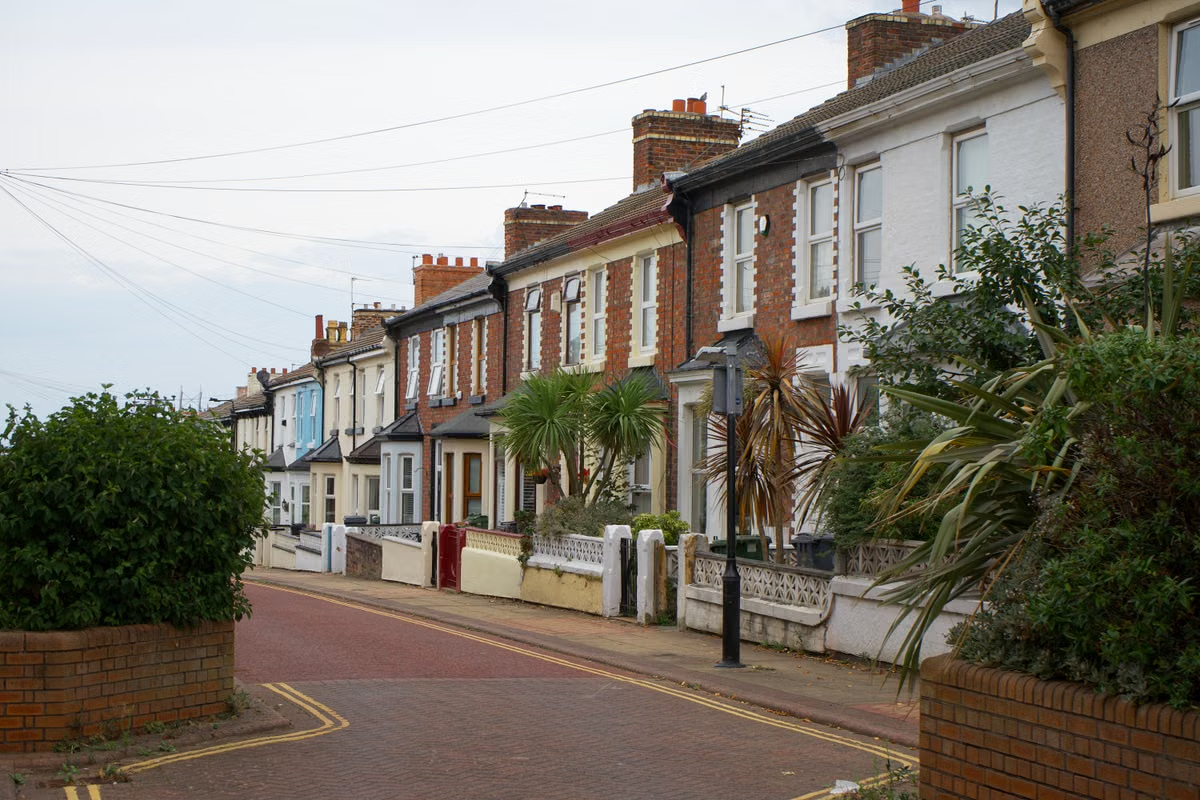
Stoke-on-Trent City Council's Cabinet has approved a city-wide Article 4 Direction that will require planning permission to convert family homes into small houses in multiple occupation (HMOs), the council announced on 8 October 2026.
The direction removes permitted development rights that currently allow such conversions to go ahead without an application. The council said it will come into force on 23 October 2026 and that Cabinet has decided the controls will take immediate effect.
The council said it must still run a statutory consultation before the direction can be confirmed, with a further report going back to Cabinet so councillors can consider responses before a final decision.
Councillor Duncan Walker, Cabinet Member for Safe and Resilient Communities and Housing, said: "Introducing an Article 4 Direction will give the council greater oversight of new HMO proposals and ensure local communities have a say through the planning process."
What changes
Once in force, the council said, applications to convert properties into small HMOs will need planning permission so that it can assess the effect on neighbourhoods, housing quality, parking, community cohesion and public amenity.
The council's existing HMO planning guidance says there are currently no Article 4 designations in the city relating specifically to HMOs, and that planning permission may be needed to convert a home into an HMO where it will have more than seven occupants. On the licensing side, a mandatory HMO licence is required for properties with five or more occupants forming two or more households.
The council defines an Article 4 Direction as a tool allowing it to remove certain permitted development rights in a particular area. Its guidance describes the legislation as permitting local authorities to require planning permission for activity that would not normally need it.
The wider package
The October decision follows a Cabinet decision in August to support enhanced regulation of HMOs. In a release published on 4 August 2026, the council described its proposals as a crackdown to limit the number of HMOs across the city.
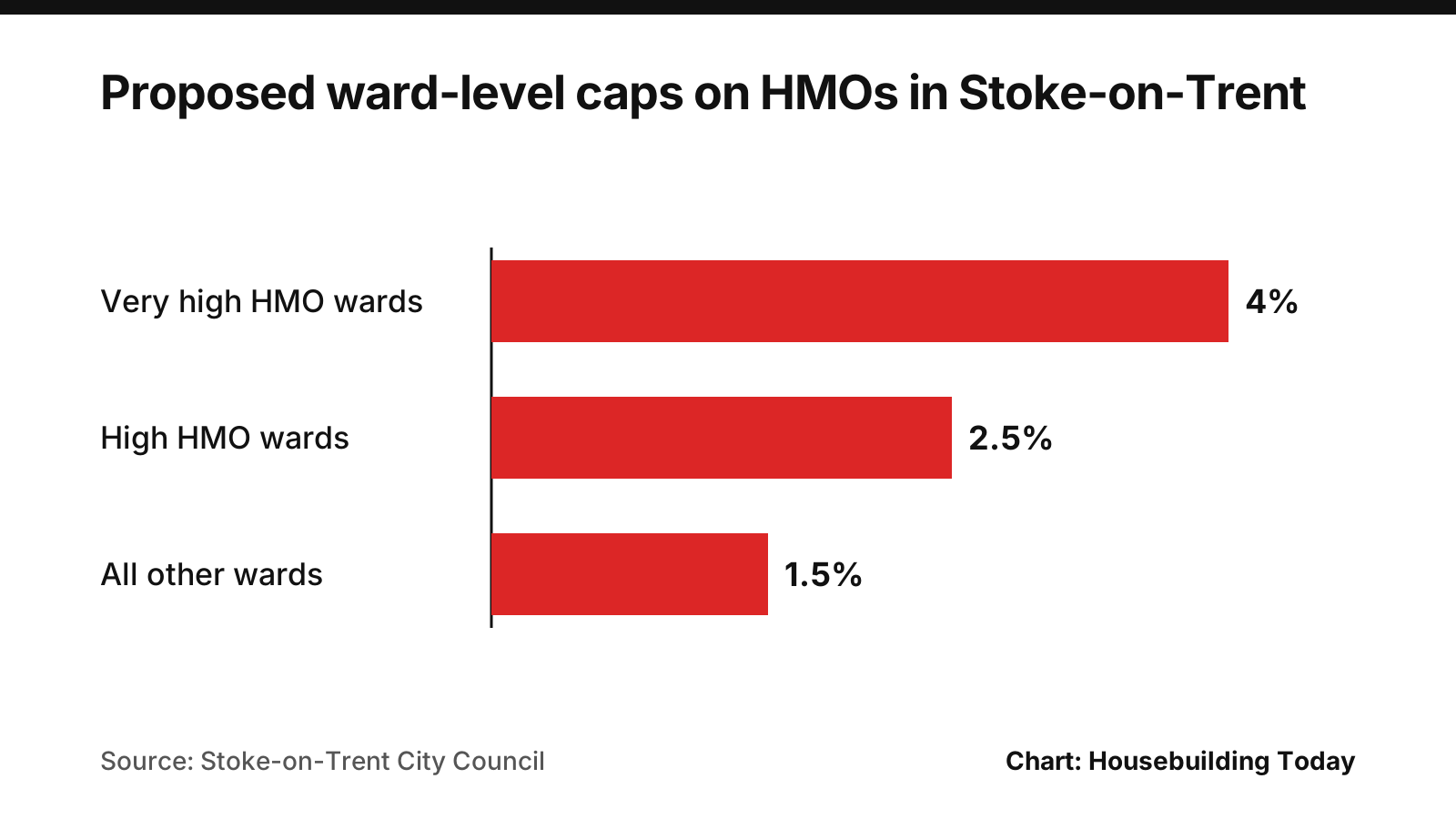
That package included the city-wide Article 4 Direction alongside a proposed planning policy under which new HMOs would not be allowed where they would push HMOs above 5% of all residential properties within a 50-metre radius. The proposals also set ward-level caps:
| Ward category | Cap on HMOs as share of residential properties |
|---|---|
| Wards with a very high number of HMOs | 4% |
| Wards with a high number of HMOs | 2.5% |
| All other wards | 1.5% |
The proposed rules would also prevent two HMOs side by side with a single frontage and stop homes being sandwiched between two HMOs. Separately, and subject to statutory consultation, the council is proposing an Additional Licensing Scheme for HMOs across the city.
The council commissioned consultants to review the impact of HMOs in Stoke-on-Trent. According to the council, they found that in all but one of the city's wards at least 1% of homes are HMOs, with much higher proportions in some urban areas.
Councillor Walker said in August: "The evidence in Stoke-on-Trent shows HMOs are concentrated in a number of urban neighbourhoods." He said the measures were a proportionate response and that HMOs needed to be of high quality and proportionate.
The council had earlier launched a review of HMOs in the city on 9 December 2025. At that time Councillor Chris Robinson, cabinet member for housing and planning, said smaller HMOs were an essential part of the housing market.
National policy
The council said its proposal is supported by recent changes to national planning policy, which now recognises Article 4 Directions as a way to address over-concentrations of small HMOs where there is clear evidence to justify intervention.
The National Planning Policy Framework chapter containing policy DM10, on removal of national permitted development rights, was published on GOV.UK by the Ministry of Housing, Communities and Local Government on 29 September 2026. The policy names preventing an over-concentration of small HMOs as an example of a justified use of an Article 4 direction.
DM10 also says such directions should be limited to situations where necessary to protect local amenity or the wellbeing of the area, be based on robust evidence, and apply to the smallest area required to mitigate the evidenced harm.
What happens next
The council said that, if approved, notices for the statutory consultation will be published through local advertisements, its website and site notices, and residents, businesses and stakeholders will be able to submit views. A further report will then go to Cabinet before a final decision on confirming the direction, which the council said takes effect from 23 October 2026.
On the record: Ministry of Housing, Communities and Local Government
Sources
- Stoke-on-Trent City Council (opens in a new tab) (accessed 2026-10-08)
- Stoke-on-Trent City Council (opens in a new tab) (accessed 2026-10-08)
- Stoke-on-Trent City Council (opens in a new tab) (accessed 2026-10-08)
- Stoke-on-Trent City Council (opens in a new tab) (accessed 2026-10-08)
- Stoke-on-Trent City Council (opens in a new tab) (accessed 2026-10-08)
- Stoke-on-Trent City Council (opens in a new tab) (accessed 2026-10-08)
- Ministry of Housing, Communities and Local Government (GOV.UK) (opens in a new tab) (accessed 2026-10-08)
This story was researched from the primary sources above and checked against them before publication. Spotted an error? Tell us and we will correct it promptly.