policy
HM Land Registry publishes guide on option agreement reporting rules starting April 2027
Practice guide 84 sets out how developers, promoters and others holding options, conditional contracts and pre-emption rights over registered land in England and Wales must report them from 6 April 2027.
HM Land Registry has published a practice guide setting out how developers and land promoters must report option agreements, conditional contracts and pre-emption rights over registered land in England and Wales from 6 April 2027.
Practice guide 84, published on 26 October 2026, explains when information about contractual control rights must be given to the registry under the Provision of Information (Contractual Control) (Registered Land) Regulations 2026, what is required and how and when to submit it.
HM Land Registry said the requirements would make it easier to see who has influence over how land is used and developed, even where ownership has not changed. The registry said its digital submission service will open on 6 April 2027 and that it expects to publish contractual control data publicly from April 2028.
Who must report and when
According to the guide, the grantee of a contractual control right carries the duty to provide the information, and must ensure it is filed by a conveyancer using the registry's digital systems. Separate HM Land Registry guidance says the submission must be made personally by an individual regulated to carry out conveyancing activities, not by a paralegal or other unregulated employee of a conveyancing firm.
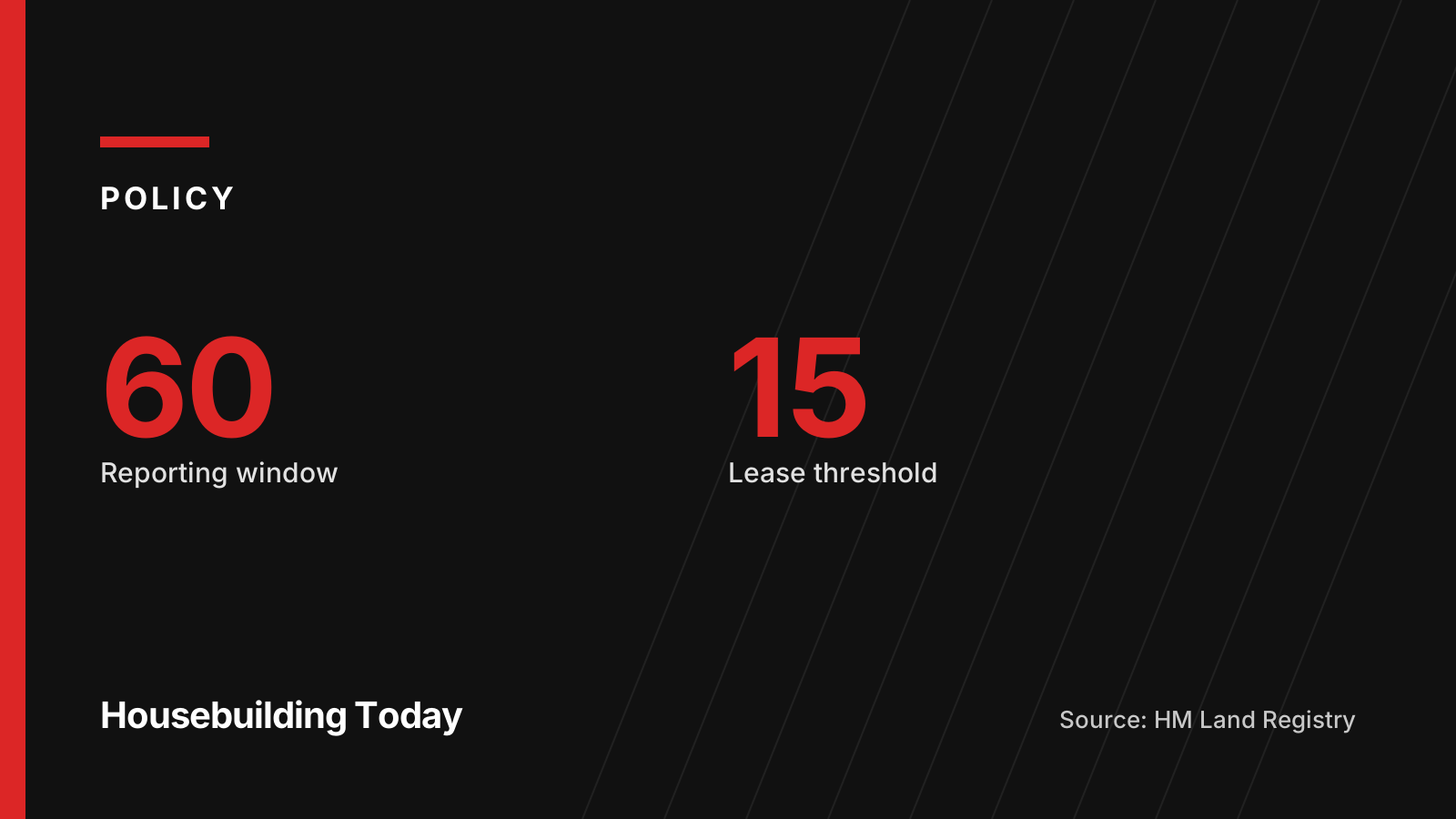
Once the rules are in force, a grantee has 60 days from the grant of a right to provide the information. The regulations, made as Statutory Instrument 2026 No. 615, also require information within 60 days of other listed events such as an assignment or variation.
There is a catch-up period for deals already being done. The guide says that for rights granted between 8 June 2026 and 5 April 2027, the grantee must provide the information before 6 October 2027. HM Land Registry's scenarios guidance, published the same day as the practice guide, confirms that no contractual control information can be submitted before 6 April 2027.
What falls outside the regime
The guide says a contract for the grant of a lease with a term of less than 15 years is outside the scope of the rules. The regulations define a relevant disposition to include the grant of a lease of 15 years or more.
The scenarios guidance says the regulations apply to each contractual control right individually rather than to the whole of a contract. Its worked examples include a registered social landlord entering a golden brick contract where the landlord does not intend to develop the land itself. HM Land Registry said the scenarios guidance does not modify or override the text and meaning of the regulations.
Information and plans
HM Land Registry advised conveyancers to retain relevant contracts, collect the dates and places of birth of grantors who are individuals, and arrange suitable spatial data where a right affects only part of a registered title.
The registry said it will not accept scanned PDF plans for identifying affected land where only part of a title is involved. It said common industry formats such as Shapefile and GeoJSON, based on British National Grid coordinates, will be supported, and that it will provide online mapping tools so conveyancers can identify affected land.
Sanctions
The scenarios guidance says failing, without reasonable excuse, to provide required information will be an offence under section 225(1) of the Levelling-up and Regeneration Act 2023. Regulation 10 of the regulations also allows the registrar to refuse to register or update a notice or restriction where the information has not been provided.
Background
The powers derive from Part 11 of the Levelling Up and Regeneration Act 2023. The government's consultation, which ran for eight weeks from 24 January to 20 March 2024 under the then Department for Levelling Up, Housing and Communities, said it was committed to improving the transparency of who owns and controls land in England and Wales, and that anyone should be able to find out not just who owns land but who controls it.
The consultation described contractual controls as a common feature of the land market that allow developers to secure land intended for development while they acquire the necessary permissions. It also said such agreements sometimes act as a blocker to communities and SMEs securing land for development.
HM Land Registry announced on 12 June 2026 that the regulations had been made and would come into force on 6 April 2027, with information to be submitted digitally through a regulated conveyancer.
What happens next
The registry is developing a new digital service for conveyancers to record and submit contractual control information. In a blog post on 17 September 2026, a user researcher at HM Land Registry invited future users to take part in a private beta phase in November 2026, describing it as an opportunity for legal professionals to influence the service before its planned April 2027 launch.
HM Land Registry said it will continue to provide updates ahead of the digital service going live on 6 April 2027, with rights granted since 8 June 2026 to be reported by 6 October 2027.
Sources
- HM Land Registry (GOV.UK) (opens in a new tab) (accessed 2026-10-27)
- HM Land Registry (GOV.UK) (opens in a new tab) (accessed 2026-10-27)
- HM Land Registry (GOV.UK) (opens in a new tab) (accessed 2026-10-27)
- HM Land Registry (GOV.UK) (opens in a new tab) (accessed 2026-10-27)
- legislation.gov.uk (The National Archives) (opens in a new tab) (accessed 2026-10-27)
- HM Land Registry (GOV.UK blogs) (opens in a new tab) (accessed 2026-10-27)
- HM Land Registry (GOV.UK) (opens in a new tab) (accessed 2026-10-27)
- Department for Levelling Up, Housing and Communities (GOV.UK) (opens in a new tab) (accessed 2026-10-27)
This story was researched from the primary sources above and checked against them before publication. Spotted an error? Tell us and we will correct it promptly.